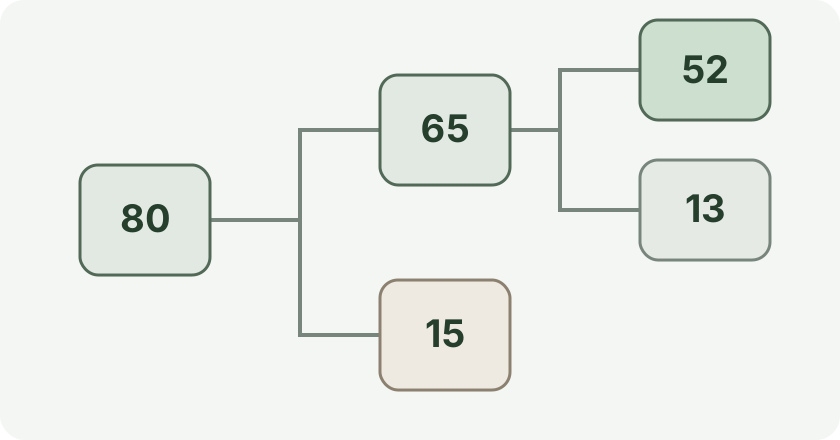
Invented counts: 52/65 is the helpful-rating fraction among respondents. The diagram does not measure quitting or explain missing answers.
- 80 participants
Enrollment is not the rating denominator.
- 65 answered; 15 did not
Keep missing ratings separate from actual answers.
- 52 helpful; 13 other responses
80% of respondents, not an 80% quit rate.
A positive sentence can leave its denominator unclear
Here is a completely fictional example with no real study or DOI. The abstract of a planning-worksheet evaluation says: ‘Eighty adults took part; most rated the worksheet helpful after one week.’ It reports acceptability, but the sentence does not say how many answered the rating question. Nor does ‘helpful’ tell you whether anyone stopped smoking.
List the immediate questions before judging: Was the rating asked of all 80? How many responded? What did the question mean? Was there a comparison group? Do not turn the summary into ‘most participants quit’ or assume unanswered questions were negative ratings.
The full text can resolve one gap without resolving everything
In this invented report, the methods describe an optional one-week feedback form with no comparison group. The results say 65 of the 80 adults answered: 52 chose ‘helpful’, 13 selected other responses, and 15 provided no rating. Thus 52/65 respondents, or 80%, chose that response. The result is not an 80% quit rate, and missing ratings cannot simply be counted as another response category.
The fuller reading repairs the denominator and explains the task. It still does not estimate the worksheet's effect: an optional acceptability question without a comparator cannot answer that. If the methods contain no smoking-status outcome, say the study evaluated feedback rather than quitting; do not claim an omitted result exists.
Now suppose the abstract says nothing about unwanted effects. Check the methods and any supplement for how they were sought and reported. Silence in the abstract is not ‘none occurred’. If the full materials do not explain assessment, leave that as unknown; do not retrofit this nonmedical worksheet exercise into a safety trial.
Missing detail, inconsistency and nonmeasurement need different responses
ICMJE asks abstracts to reflect the article and note important limitations. If the abstract and the results give different denominators, check definitions and any correction rather than choosing the more impressive number.
‘Not in the abstract’ means read the relevant methods, results or supplement. ‘Not found after those checks’ means record what you could access. ‘Not measured’ needs support from the study's declared measurements. A paywall or unlinked supplement is an access limit, not proof of concealment.
Leave a note with resolved and unresolved parts
For the fictional case: ‘One-week feedback, no comparison group: 52/65 respondents rated the worksheet helpful; 80 adults participated, with 15 missing ratings. No quitting outcome is specified in the methods described here. Unwanted-effect assessment remains unverified.’ Each clause says where the reading ended.
For a real article, keep its actual record and the exact table or section needed to recover your note. You can request a public manuscript without personal smoking details. Questions about choosing your own quitting support or treatment belong with a qualified local clinician or cessation professional, not a reconstructed abstract.
What to keep in mind
Common questions
Can an abstract be useful without the full text?
Yes, for identifying the study question and a provisionally described result. Say that your reading is abstract-only and retain unresolved fields. It is not a completed critical appraisal.
Sources
The central claims on this page were checked against the sources below.
- NCCIH, National Institutes of Health: How To Make Sense of a Scientific Journal Article — Abstract and Main Sections
Sources checked: 2026-10-03
- International Committee of Medical Journal Editors (ICMJE): Preparing a Manuscript — Abstract
Sources checked: 2026-10-03
Research-reading guidance with a wholly invented case. It establishes no quitting effect, safety conclusion or personal treatment recommendation.