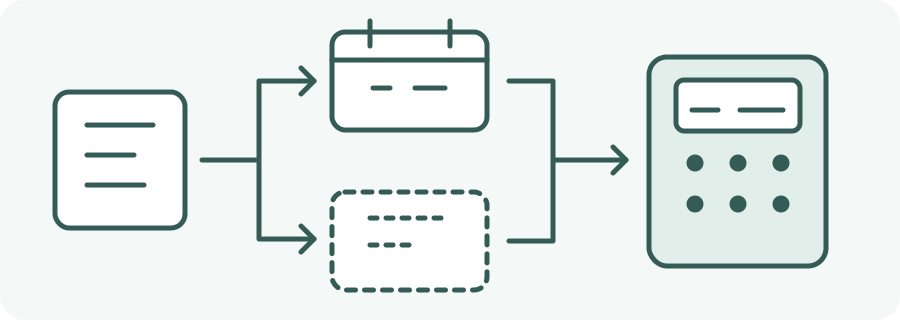
Conceptual editorial diagram of observation and modelling, not the paper's original figure or a personal success pathway. The dashed branch means incomplete observation, not failure.
- Reported attempt
A conscious attempt, recalled over six months.
- Outcome observed
Follow-up assesses the study's one-year definition.
- Observation incomplete
The available follow-up cannot fully establish the outcome.
- Population estimate
A life table uses observations and censoring assumptions.
One dataset, different questions
Selected overall estimates from original Table 3, not personal targets. Method 1 is 6.3 in that table and the Results text, while the abstract says 6.1; this page retains the table value rather than silently combining them.
| Method | Overall estimate | What changes in the calculation |
|---|---|---|
| 1: recall among successful quitters | 6.3 attempts | Includes those reaching the study outcome; relies on recalled earlier attempts. |
| 2: constant probability | 19.6 attempts | Assumes independent attempts with the same probability of success. |
| 3: life table of observed attempts | 29.6 attempts; 95% CI 27.6–31.6 | Allows the observed success rate to vary by attempt number and adjusts for incomplete observation. |
1,277 people are not 3,362 different people
The Ontario Tobacco Survey interviewed adults at roughly six-month intervals for up to three years; interviews ran from 2005 to 2011. This analysis selected 1,277 people who smoked in the past month at baseline and reported a serious attempt in one of the first three follow-ups. They reported 3,362 attempts. The broader survey's 4,501 recent smokers are not this analysis's denominator.
An attempt meant a conscious effort to stay off cigarettes for good, reported for the previous six months. It did not have to last 24 hours. The outcome was at least one year without smoking, assessed by self-reported time since the last cigarette, without biochemical verification. An attempt count therefore is not a count of year-long quits, and the outcome is not proof of permanent cessation.
Where 29.6 comes from—and where observation stops
Method 3 did not watch every participant make about 30 attempts. It used observed success rates at different attempt numbers to build a life table for a theoretical cohort, then estimated an average from the area under its curve. ‘First observed attempt’ was not necessarily a person's first ever: earlier attempts were excluded from this method. Method 4 added lifetime recall, introducing a different selection problem because people who had already quit before entry were absent.
Some outcomes could not be fully ascertained before follow-up ended. Right censoring represents that observation limit, not automatically a failed attempt. The life table adjusted for it. The diagram separates reported records, outcome observation and estimation; it is not a path an individual has to complete. The confidence interval describes uncertainty in the model estimate, not the range of attempts assigned to each person.
A changing group rate is not your next-attempt probability
People reaching the outcome leave the group still being followed for success; those remaining at later attempt numbers can differ from those at earlier numbers. This observational pattern does not show that trying again itself causes worse prospects for one person. Six-month recall can still miss attempts, the one-year outcome can be followed by later smoking, and treatment/support exposure was not randomly assigned. The comparison table does not test a best method of quitting or a universal modern average across countries.
Ask for the source, not a quota
If a headline says ‘it takes 30 tries’, ask which population, attempt definition, endpoint and calculation it means. This paper does not set a minimum to reach before seeking help, an upper limit or a deadline. NHS information describes support options in England; elsewhere use your current local service and confirm its arrangements. Reading the number needs no disclosure of your own history, and this page does not collect it.
What to keep in mind
Sources
The central claims on this page were checked against the sources below.
- BMJ Open / PMC: Chaiton et al. (2016): original Ontario cohort, attempt and outcome definitions, four estimation methods, Table 3 and limitations
Sources checked: 2026-10-08
- NHS Better Health: England: professional quitting-support options
Sources checked: 2026-10-08
Population-research explanation, reviewed 8 October 2026. No personal attempt quota, probability, diagnosis, treatment choice or outcome promise; no personal inputs.