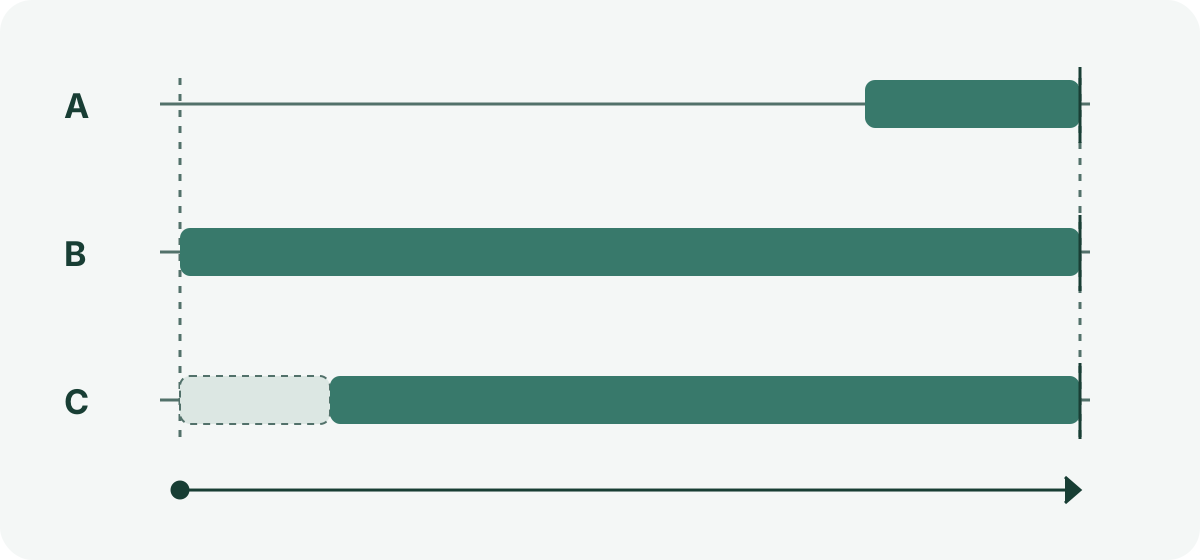
A conceptual diagram, not a scale drawing or study result. The right-hand marker is the assessment; the left-hand marker is the stated quit date. Read each row’s rule below.
- A · Point-prevalence
Only the specified recent window before assessment is counted.
- B · Continuous
The full interval from the quit date is counted, with no initial grace period.
- C · Prolonged
The initial dashed block is a grace period; the later interval is counted. Any permitted lapses still need an explicit rule.
A visit date is not a smoke-free duration
Seven-day point-prevalence abstinence asks about the seven days before an assessment. Someone who stopped later in the study can meet that definition even if they smoked earlier. Repeating the question at several visits creates repeated snapshots, not a complete record of the gaps between them.
Continuous abstinence instead covers the whole specified interval from the quit date to the assessment, with no initial grace period in the SRNT definition. Check that the paper uses the same meaning: labels have not always been used consistently.
What a grace period changes
Prolonged abstinence usually starts after a specified initial grace period. The study might disregard smoking during that initial period when judging this outcome. Some prolonged definitions also permit a stated amount or pattern of lapses; others permit none after the grace period.
Neither ‘two weeks’ nor ‘five cigarettes’ is a universal allowance. Those are examples of rules used in research, not advice about how much smoking is acceptable. Find the paper’s start point and lapse rule before comparing it with another study.
One fictional history, different answers
Fictional example: a participant sets a quit date, smokes once during the first week, then reports no smoking through a six-month visit. A seven-day snapshot can count the final week as abstinent. A continuous definition starting on the quit date cannot count the entire interval as abstinent.
A prolonged definition with a two-week grace period and no later smoking could count the period after that grace period as abstinent. This example explains classification only; it is not a real participant, study result or predicted quit rate.
Stopped cigarettes, tobacco or all nicotine?
A study of cigarette smoking may allow other products within its endpoint; another may include cigars, smokeless tobacco or alternative products. A statement about stopping cigarettes therefore cannot silently become a statement about stopping all tobacco or nicotine.
The SRNT review separates product scope from duration. Its proposed rule records FDA-approved nicotine cessation medicines without treating their use as a violation of smoking abstinence. That is the paper’s rule, not a statement about approval in every country or a personal medication instruction.
Copy the rule alongside the number
When saving a public result, write: assessed at six months; no specified products during the previous seven days; self-report or stated verification method; stated rule for missing follow-up. If any field is absent, keep it marked ‘not reported’ rather than filling it in from another article.
For questions about your own care, take the source to a qualified local professional. In England, the NHS directory can help you find a Stop Smoking Service; contact it before visiting. Ask the provider what its own follow-up figure means rather than assuming it uses a trial definition.
What to keep in mind
Common questions
Does a seven-day endpoint mean only seven days of follow-up?
No. A study can follow people for six months and ask about the final seven days. The follow-up locates the visit; the seven-day window defines the behaviour being counted.
Is one definition always the correct one?
No single window answers every research question. The useful comparison is between clearly specified, compatible outcomes, not between labels ranked as good or bad.
Does one cigarette erase my personal progress?
A research classification is not a judgement about you. A particular endpoint may no longer be met, while other observations remain true. If you are enrolled in a study, report what happened accurately; the study team applies its protocol.
Can a test at the final visit prove six months without smoking?
A specimen has a limited detection window. One end-of-study sample cannot reconstruct every earlier day. Read the behaviour question and verification method separately.
Sources
The central claims on this page were checked against the sources below.
- Society for Research on Nicotine and Tobacco / Piper et al.: SRNT — Defining and Measuring Abstinence (2019 online; 2020 journal issue), definitions and Table 1
Sources checked: 2026-10-01
- Society for Research on Nicotine and Tobacco / Benowitz et al.: SRNT — Biochemical Verification: 2019 Update (2020 issue), limits of a single specimen
Sources checked: 2026-10-01
- NHS Better Health: Find your local Stop Smoking Service (England)
Sources checked: 2026-10-01
General information about research definitions, not an individual assessment or a rule for choosing treatment. Personal clinical questions belong with qualified local care.