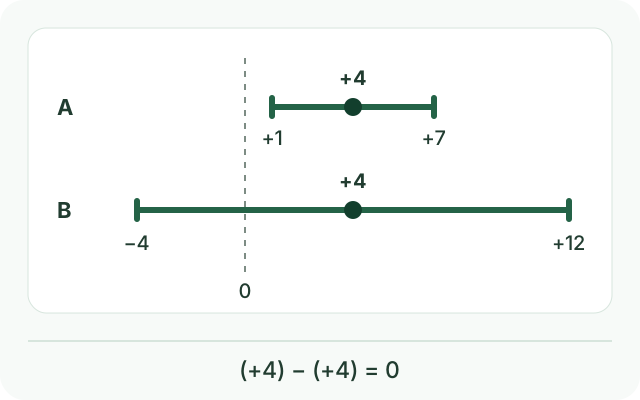
Invented 95% summary intervals, not real cessation results. All numbers are percentage points. Zero is the no-difference reference within each subgroup; this is not a completed test of A versus B.
- A and B: +4
The reported point estimates are equal, despite different significance labels.
- (+4) − (+4) = 0
This is a difference of point estimates, not proof of equal underlying effects or a replacement for its interval.
Read past the headline to the two dots
This is a wholly invented report, not a real trial, product or effect estimate. Adults were randomly allocated to ordinary consultations with or without an additional group meeting. A and B describe fixed versus variable work schedules recorded before allocation, not which support people later used. Both subgroups have the same defined six-month outcome.
The fictional report estimates an absolute difference of +4 percentage points in both subgroups. Its illustrative 95% intervals are +1 to +7 for A and −4 to +12 for B; it labels only A statistically significant. These are invented summary displays, not intervals calculated from participant counts. No actual P values or interaction result are supplied.
The two point estimates give (+4) − (+4) = 0 percentage points. That does not establish equal underlying effects: the uncertainty of their difference has not been provided. But ‘only A benefited’ adds a subgroup distinction the two significance labels do not establish. A faithful note is: ‘The estimates are the same; B is less precise; the direct comparison and its uncertainty are missing.’
Find the comparison that actually tests the headline
Look for ‘interaction’, ‘effect modification’ or a test of subgroup differences. Keep the intervention, comparator, outcome, assessment time and effect scale attached to it. An absolute difference and a ratio can show different patterns; do not silently switch scales to find the most striking row.
Read the interaction estimate and interval where reported, not only its P value. Failure to detect a difference is not proof of identical effects. Nor does a small P value settle the size, practical importance or credibility of a difference. If the report gives no direct comparison, leave that question unresolved.
The overlap of two subgroup intervals is not a substitute for the direct test. Slight overlap can still accompany a statistically detectable difference, while separate significance labels compare each subgroup with its own no-effect value rather than with the other subgroup.
Was the grouping chosen before the result was visible?
Open the dated protocol or analysis plan. Look for the proposed modifier, its categories or continuous model, expected direction and rationale. CONSORT asks authors to distinguish prespecified from post-hoc additional analyses and report their results. A bare ‘prespecified’ label is not confirmation.
Find the total search for patterns: modifiers, cut points, outcomes, follow-up times and models, plus how multiplicity was handled. Choosing the most flattering split after looking at results is different from testing a small, justified set. Even planned analyses can leave substantial uncertainty; prior evidence and independent replication matter.
A subgroup inside a trial is not a group of different trials
For a characteristic measured before allocation, a trial can compare its randomly assigned interventions within the baseline subgroups. The characteristic itself was not randomly assigned, and the analysis still needs appropriate methods, sufficient information and attention to bias. Splitting people by attendance or response after allocation is a different, potentially selected comparison.
A review that compares whole trials with mostly fixed schedules against other trials with mostly variable schedules also changes the studies being compared. Countries, background support or other study features may differ. This between-trial association cannot simply be assigned to the schedule characteristic, even when every trial was randomized.
Do not turn the research label into a personal gate
This page needs no personal work schedule, smoking history or health details. Research averages cannot decide whether you personally should receive support. NHS information lists different stop-smoking routes across the UK; check the route relevant to your location. Personal options belong with a qualified local professional, not an online subgroup label.
What to keep in mind
Sources
The central claims on this page were checked against the sources below.
- Cochrane: Cochrane Handbook chapter 10 — subgroup differences, interaction and within/between-study distinctions
Sources checked: 2026-10-04
- SPIRIT–CONSORT Group: CONSORT 2025 expanded checklist — items 3, 21d and 28
Sources checked: 2026-10-04
- ICEMAN authors: ICEMAN author manual for randomized controlled trials — prior hypotheses, interaction, multiplicity and cut points
Sources checked: 2026-10-04
- ICEMAN authors: ICEMAN preliminary considerations — outcome, time point, effect scale and baseline modifiers
Sources checked: 2026-10-04
- ICEMAN authors: ICEMAN author manual for meta-analyses — within-trial and between-trial comparisons
Sources checked: 2026-10-04
- NHS: NHS stop-smoking support routes in the UK
Sources checked: 2026-10-04
Public-research reading only. The complete example and graphic are invented; no personal prediction, diagnosis, treatment choice or data collection.