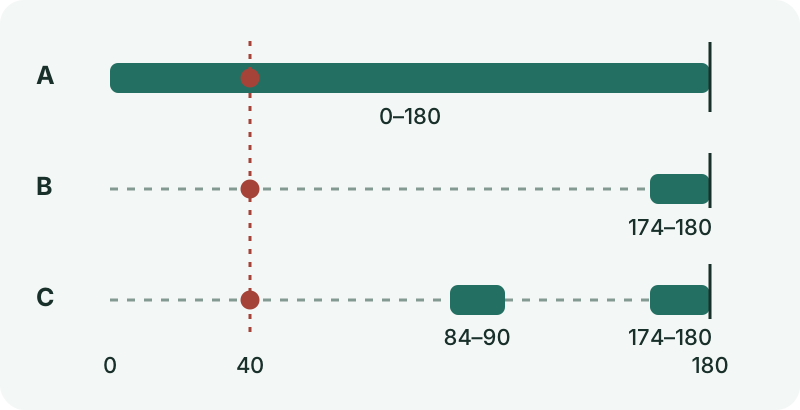
Invented history; not to scale. Green bars mark the time covered by each question, not measured success. Red marks repeat the same imagined day-40 event across rows. Final assessment is identical.
- A · 0–180
The continuous question includes the day-40 event.
- B · 174–180
The final seven-day question does not include day 40.
- C · 84–90 + 174–180
Two windows still leave day 40 uncovered; repeated point prevalence is not continuous coverage.
Fix one endpoint date before comparing
Read the actual outcome question. ‘Have you smoked since the target quit day?’ and ‘Have you smoked in the last seven days?’ are different questions even when asked at the same six-month visit. The visit date and the period being described are not interchangeable.
The SRNT review was published online in July 2019 and appeared in the July 2020 issue. Its definitions provide a useful reference, not a rule that every trial must use. Preserve the report's start date, end date and product scope; ‘no cigarettes’ does not automatically mean ‘no tobacco or nicotine products’. The protocol must settle that scope.
A day-40 event gives two different answers
Here is a fully invented example, not a trial result or anyone's record. Set the target quit day to day 0 and the final assessment to day 180. Assume the entire cigarette-smoking history is known, with no missing outcomes. For this exercise, the final seven-day window contains the labelled days 174–180, inclusive.
Suppose there was one cigarette-smoking event on day 40 and none at any other time. The day-180 seven-day point-prevalence criterion is met: the event is outside its window. Continuous abstinence from day 0 through day 180 is not met: day 40 falls inside that interval. No person has changed, and neither answer cancels the other.
Adding a second snapshot still leaves a gap
Now add a day-90 assessment of labelled days 84–90. The same imagined day-40 event lies outside that window too. The history meets both seven-day snapshots but still does not meet continuous abstinence. A second snapshot does not fill in the interval between them—or the time before the first.
Change the example to an event on day 179: the final snapshot and the full continuous interval both fail their specified cigarette rule. If there were no events anywhere in the interval, both would meet it. These classifications follow the stated windows; they are not estimates of real-world rates or advice about how much smoking is permitted.
Do not rename a grace period ‘continuous’
In the SRNT definitions, prolonged abstinence starts after an initial grace period. A separately specified prolonged-with-lapses definition can also tolerate certain smoking events. That is not the same definition as continuous abstinence from the target quit day without a grace period.
A report may use different terminology or call a later restricted interval ‘continuous’. Do not silently substitute the SRNT definition or assume an allowed lapse. Write the actual starting point and rule alongside the label. A research grace period is an analysis convention, not permission or a clinical recommendation to smoke.
What the pair of percentages can and cannot say
To compare the two endpoints in a real paper, first match assessment dates, products and the analysed population. Then check how each endpoint uses self-report, verification and missing information. A recent sample cannot turn a snapshot into a complete event history.
Under the same strict cigarette rule, same final date and fully known histories, meeting the continuous interval also meets a seven-day window contained within it. Different denominators, missing-data conventions or dates can break that simple numerical comparison in reported tables. If the percentages look reversed, inspect those fields rather than invent a personal explanation or declare the report false.
Read the paper, not your own history, into this exercise
A faithful description is ‘seven-day point-prevalence cigarette abstinence assessed at six months’, not ‘continuously smoke-free for six months’. Keep the longer wording when it prevents the wrong conclusion. Use the public protocol and group-level results; no personal dates or health information are needed, and this page collects none.
Personal support is a separate question
The NHS provides a route to local stop-smoking support in England. If you are asking what to do about your own smoking rather than how an endpoint was counted, contact a qualified local professional or current support service. A research classification cannot select treatment or judge the value of your effort.
What to keep in mind
Sources
The central claims on this page were checked against the sources below.
- SRNT Treatment Research Network / Nicotine & Tobacco Research: Defining and Measuring Abstinence in Clinical Trials of Smoking Cessation Interventions: An Updated Review — Tables 1–2
Sources checked: 2026-10-04
- NHS: Ready to quit smoking — local support
Sources checked: 2026-10-04
General research literacy, not a personal abstinence assessment, test interpretation or treatment recommendation. The event history is fictional. No personal smoking dates, medical details or inputs are collected or stored; individual care questions belong with qualified local help.