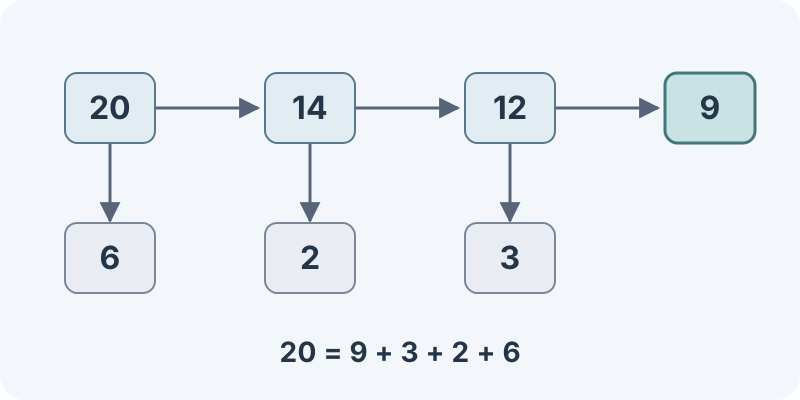
All counts invented. Boxes on the main path are nested, not separate populations to add. The four final branches sum to 20: 9+3+2+6. The full original cohort of 100 is not shown.
- 20 → 14
Six do not return; 14 return. Return is not confirmation.
- 14 → 12
Two returned samples are unusable.
- 12 → 9
Nine satisfy the invented criterion; three do not. Neither missing branch identifies dishonesty.
Start with the 20 people asked to return a sample
This entire exercise is invented; it is not a real trial, laboratory result or sampling instruction. All 100 original participants answer the six-month question about cigarette smoking in the preceding seven days. Twenty report no smoking, not even a puff; 80 report some smoking. Only the 20 reporting abstinence are asked to return one sample each.
Fourteen return a sample. Twelve of those samples are usable; two are not. Nine of the 12 satisfy the fictional report's prespecified verification rule and three do not. The rule's assay and thresholds are deliberately unspecified: this is a count-reading exercise, not a way to interpret anyone's test.
The report had defined its verified endpoint as both the qualifying self-report and confirmation under that rule, using all 100 original participants as the denominator. Anyone without both is counted as not meeting this endpoint. That is the exercise's analysis rule, not a finding that every unconfirmed person smoked.
The same chain gives 70%, 75%, 45% and 9%
Return among requests is 14/20=70%. Usability among returns is 12/14≈85.7%. Agreement with the stated abstinence report among usable samples is 9/12=75%. Confirmation among all 20 self-reporters is 9/20=45%. None is the full-cohort verified endpoint, which is 9/100=9%, compared with self-report 20/100=20%.
The 11 without documented confirmation split into six non-returns, two unusable samples and three usable results not satisfying the rule: 6+2+3=11. Saying ‘55% of the self-reporters lied’ would turn an absence of confirmation into a known motive and behaviour. The exercise supplies neither. Even the three inconsistent usable results do not establish dishonesty.
A faithful summary is: ‘In this fictional cohort, 20 reported seven-day cigarette abstinence; nine also met the preset verification criterion. Of 20 requests, 14 samples returned and 12 were usable.’ There is no comparison group, intervention effect, future forecast or evidence about all nicotine products.
In a real report, match the request population to each denominator
The remote-verification review recommends reporting returns, usable samples, self-reported and verified abstinence, and agreement or disagreement separately for study groups or conditions. If only self-reporters are asked for samples, a return rate among requests is not a return rate among everyone enrolled. If multiple samples are requested per person, sample counts also need not equal participant counts.
Use the protocol and report to identify the product scope, endpoint window, self-report assessment and sample-collection dates, verification rule, analysis population and handling of absent or unusable confirmation. Do not assume a sample proves an entire abstinence period. Also check how the report addressed who supplied the sample and other product use; no identities or test records need to be shared here.
Compare those stages by trial arm, not just in a pooled total. Unequal return or usability can affect how a between-group result is read. Do not silently discard unconfirmed cases or substitute a more favourable denominator; retain the stated analysis and examine its assumptions.
What remains unknown after reconstructing the chain
The review reported incomplete and inconsistent descriptions of non-return, technical problems and unusable samples. Participant burden or inconvenience are possible explanations, as is continued smoking; without the relevant evidence, a reader cannot assign a reason to each person. More detailed flow makes the uncertainty visible but does not recover every unknown outcome.
The review's heterogeneous studies do not turn an association with a collection method into proof that one remote method is best. Nor does a lower verified rate alone establish a truer rate. This page does not choose a device, explain biomarkers or cutoffs, tell you how to collect a sample, or interpret a personal result.
Personal support is separate from a study's verification label
NHS Better Health provides routes to professional stop-smoking support. For help relevant to your circumstances, contact a qualified local service and confirm current arrangements. You do not need to upload samples, photos, identification, smoking records or health details to read this page or ask for support.
What to keep in mind
Sources
The central claims on this page were checked against the sources below.
- Nicotine & Tobacco Research: Remote biochemical verification scoping review — requests, returns, usable samples and uncertain discrepancies
Sources checked: 2026-10-04
- SPIRIT–CONSORT Group: CONSORT 2025 expanded checklist — endpoint definitions, flow, analysis populations and missing-data rules
Sources checked: 2026-10-04
- NHS Better Health: Ready to quit smoking — local professional support
Sources checked: 2026-10-04
Reading public research reports only. All diagram counts and the verification rule are fictional. No personal test interpretation, medical sampling procedure, equipment advice or treatment choice. No personal input, storage or transmission.