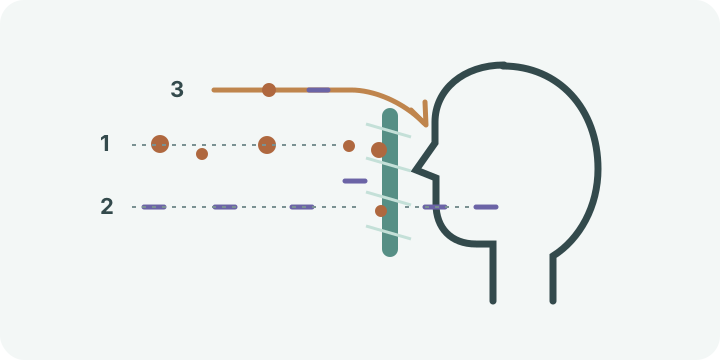
Schematic, not a device recommendation or efficiency measurement.
- 1 · Through the material
Some particles can be captured; no percentage is depicted.
- 2 · Gas route
A particle filter does not cover harmful gases or vapours.
- 3 · Around the edge
A gap gives particles and gases a route around the material.
A smoke mixture is not one particle test
A filter can capture particles passing through its material. That is a narrower claim than removing every component of tobacco smoke. Cloth or disposable face coverings, filtering facepiece respirators and devices with specialised cartridges are not interchangeable categories. This page does not select a device for any of them.
For example, the 95 in N95 means at least 95% particle filtration under specified test conditions, not 95% removal of tobacco smoke from a room or a 95% reduction in a wearer's health risk. A test percentage cannot be applied to the entire smoke mixture or absorbed dose. Calling every smoke particle too small to filter is also wrong: what the filter was designed and tested to remove matters.
The air route around the face still matters
Material performance assumes air passes through that material. Gaps create another route. Fit, condition and use affect performance; the name printed on a package does not establish how a device performs on a particular wearer throughout a task.
Less noticeable odour is not a seal test or a measurement of all gases. Do not deliberately stand in smoke to test a covering. This article provides no fit assessment, wear schedule or clearance for someone with a health condition; those questions require qualified advice.
Follow the reception-desk example
Fictional example: smoke from visitors near an entrance reaches reception whenever the door opens. Someone suggests giving the receptionist a mask with a high particle-filtration claim. The claim answers a filter question, while the unresolved problem is smoke entering an occupied work area.
The useful questions are whether smoking can be kept out of that route, who handles visitor instructions, and how facilities staff will review the entrance and intake arrangements. Moving pollution or supplying a covering does not demonstrate elimination.
Ask about control, then the responsible programme
In the United States, NIOSH places required workplace respirator use within a respiratory-protection programme. A supervisor, safety professional or occupational-health service can address the hazard assessment; federal, state and local smoke-free coverage differ. A consumer purchase is not a substitute for that process.
For a private reminder, write only three questions: what smoke component is covered, what protection in actual use is established, and what will stop the source reaching the task? Keep it on private paper. The site needs no employer name, schedule, health history or device data. Personal health concerns belong with a qualified clinician.
What to keep in mind
Common questions
Does the number in a filtration label mean the same reduction in tobacco exposure?
No. A test percentage does not measure the whole smoke mixture or the protection achieved by an individual wearer.
Sources
The central claims on this page were checked against the sources below.
- CDC / NIOSH: Community respirators and masks: particulate filtration, gases and face leakage
Sources checked: 2026-10-08
- US EPA: Secondhand smoke: particles, gases and indoor source control
Sources checked: 2026-10-08
- CDC / NIOSH: Workplace tobacco policy includes entrances, air intakes and vehicles
Sources checked: 2026-10-08
General protection-limit education, without PPE selection, personal fit assessment, safe exposure time or individual health predictions.