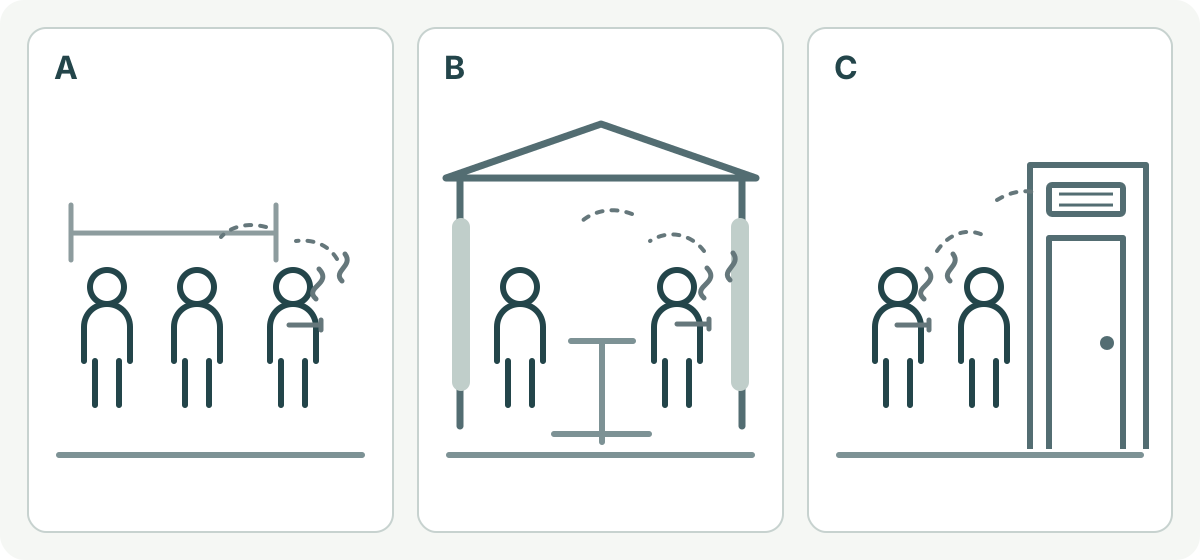
A spatial comparison, not a map of safe and unsafe zones. The suggested questions are editorial examples.
- A — Queue
Can you wait elsewhere without losing your place?
- B — Covered seating
Can the venue offer a different seating or meeting arrangement?
- C — Entrance
Can waiting and smoking be kept away from the access route and openings?
In a queue, changing places is not always your decision
Fictional editorial example: you are waiting at a ticket entrance and the person ahead lights a cigarette. Walking away could mean losing your place. Ask the attendant: ‘Can I wait to the side and keep my place, or is there another queue?’ That is a request about the arrangement, not a demand that the attendant identify a health risk.
If there is no attendant, you might ask a companion to hold your place where the rules allow, choose another entrance, or return later. Do not push through the crowd or feel obliged to confront a stranger. None of these options is labelled a guaranteed safe spot.
A roof and side walls matter even when the sign says outdoor
An open pavement, an awning with side screens and a doorway are not interchangeable. The EPA distinguishes outdoor exposure from the greater accumulation often found indoors; it does not give a universal outdoor distance that makes every setting exposure-free.
On a terrace, ask for a different arrangement rather than an extra metre
Fictional editorial example: rain has moved everyone beneath a café awning, with smoking at the next table. A useful question is: ‘Is there a seating area without smoking nearby, or can we wait inside where smoking is not allowed?’ Check what the venue can actually offer. Moving one chair within the same covered area may not solve your concern.
If you are organising the meeting, agree on the location before guests arrive. An alternative venue or a takeaway meeting is a different arrangement; ‘we will sit upwind’ is not a lasting promise about changing air.
A doorway is also a route into the building
The EPA advises keeping outdoor smoking sources away from doors, open windows and air intakes, as well as vehicles and enclosed spaces. Moving smoking just outside the door is not the same as keeping smoke away from people and openings.
If you can influence where people wait or smoke
For a host or venue worker, separate the place where people must wait from the place where smoking occurs. Keep access routes clear. Ask the site manager about the actual smoke-free arrangements rather than sending people to another doorway or intake.
For a passer-by, a short request can be enough: ‘Could I use the other entrance while people are smoking here?’ If the situation becomes tense, leave the discussion and ask staff for help. This page does not determine local smoking rules or require confrontation.
What to keep in mind
Common questions
How many metres should I move?
There is no universal distance on this page. A fixed number would ignore the source and the particular space. Choose a different arrangement with no nearby smoking source where possible, without labelling it exposure-free.
Does standing upwind solve it?
A momentary wind direction is not a dependable arrangement for a whole wait or meeting. Do not rely on it as a guarantee; consider another place or time instead.
If outdoor smoking is permitted, does that mean the smoke is harmless?
Permission and exposure are different questions. Check local rules separately; a permitted location is not proof that the smoke cannot reach someone else.
Sources
The central claims on this page were checked against the sources below.
- US Environmental Protection Agency: Outdoor secondhand-smoke exposure compared with indoors — updated 2025-11-13
Sources checked: 2026-10-01
- US Environmental Protection Agency: Secondhand smoke and electronic-cigarette aerosols — outdoor sources near openings; updated 2026-06-09
Sources checked: 2026-10-01
General environmental-health information and editorial examples, not a personal exposure calculation or a ruling on a venue's legal duties.