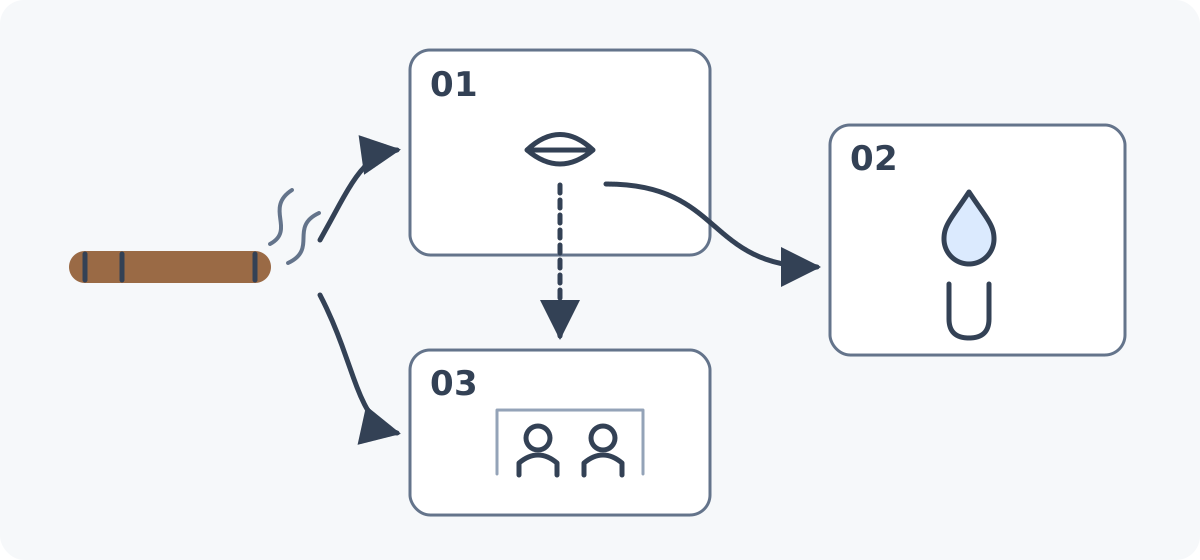
Arrows show contact paths, not equal doses, personal disease probabilities or a sequence of health outcomes.
- Mouth
Direct contact remains; nicotine can be absorbed through the mouth lining.
- Swallowed saliva
Saliva that contacted smoke can carry substances to the esophagus.
- Shared air
Smoke from the cigar and exhaled smoke can reach other people.
What ‘I do not inhale’ actually answers
Fictional exchange: a friend says, ‘I only hold cigar smoke in my mouth, so nothing reaches me.’ The useful distinction is between the reported action and the conclusion. You can accept the description without accepting ‘no exposure’.
Mouth contact and nicotine absorption
NCI explains that cigar smoke directly contacts tissues in the mouth and throat even without inhalation. Nicotine can enter through the lining of the mouth. CDC's current cigar guidance also states that people who report not inhaling remain exposed to nicotine and toxic substances.
NCI and CDC identify cigar smoking as a cause of cancers including the mouth, throat and esophagus. These are population-level health findings about smoking, not simply a nicotine-absorption measurement. They do not predict whether a particular person will develop cancer or make every pattern of cigar use equivalent.
The swallowed-saliva route is separate
NCI describes another route: saliva exposed to smoke is swallowed, bringing smoke-related substances into contact with the esophagus. This is why a diagram limited to lungs would miss part of the explanation.
People nearby are not protected by your inhalation choice
The NCI's separate secondhand-smoke fact sheet defines smoke from a burning tobacco product and smoke exhaled by a user as contributors to secondhand smoke. Its cigar page describes indoor pollution, while CDC identifies cigar secondhand smoke as harmful to people nearby.
An agreement not to smoke around others concerns a shared space, not a claim that your own exposure has vanished.
A more useful personal question
Instead of ‘how do I puff safely?’, you can ask a qualified professional, ‘I use cigars without intending to inhale; what support is available if I want to stop?’ In England the NHS source below links an adviser finder, with separate routes for other UK nations. Outside the UK use an official local service; confirm its current arrangements.
What to keep in mind
Common questions
What if I only smoke a cigar occasionally?
This page cannot calculate an individual's risk from frequency alone. Occasional use does not turn the remaining contact routes into no exposure; discuss personal concerns with a qualified professional.
Sources
The central claims on this page were checked against the sources below.
- US National Cancer Institute: Cigar Smoking and Cancer — reviewed 27 October 2010
Sources checked: 2026-10-01
- US Centers for Disease Control and Prevention: Cigars: exposure even without reported inhalation — 10 September 2024
Sources checked: 2026-10-01
- US National Cancer Institute: Secondhand Smoke and Cancer: smoke-source definition — reviewed 4 December 2018
Sources checked: 2026-10-01
- NHS: Official stop-smoking routes for England and other UK nations
Sources checked: 2026-10-01
General exposure education, not a personal risk calculation, diagnosis or safer cigar-smoking technique.