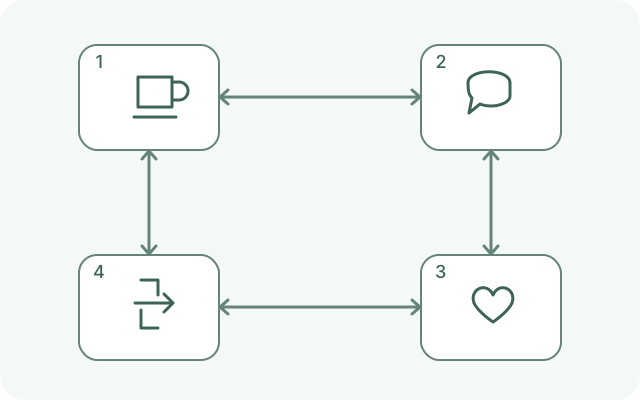
Explanation of the NHS CBT concept, not a validated smoking model, a measured causal chain or instructions to perform therapy. Numbers are labels, not a required order.
- 1 · Situation
A colleague invites the person outside.
- 2 · Thought
‘Otherwise I lose my social break.’
- 3 · Feeling
Feeling left out in this invented example.
- 4 · Action
Going to the smoking area; the diagram does not make this inevitable.
The same break can mean different things
In a fictional example, a colleague invites someone outside. The person thinks, ‘If I stay here, I lose my only social break,’ feels left out and goes to the smoking area. Another person might go there automatically, without that thought. Similar visible behaviour does not establish the same explanation. The illustration makes these possible connections visible; it does not measure a brain mechanism or diagnose either person.
A professional discussion can examine what actually happens, how the person understands it and which alternatives are realistic in their circumstances. The aim is not to replace every uncomfortable thought with an upbeat slogan. Thoughts, feelings and actions can influence one another; the diagram is not an inevitable sequence or a self-treatment exercise.
Information and supported practice are different offers
Explaining smoking risks is education. CBT programmes may also include examining interpretations, discussing difficult situations, rehearsing skills and reviewing how they worked with a practitioner. The components and delivery differ between studies. A downloadable list with the same vocabulary is not automatically equivalent to the professional programme.
Ask a provider what their smoking-cessation training is, who supervises the work and what happens when the first approach does not fit. Also ask how group or individual appointments work and whether other cessation care is available. Session counts advertised for CBT in other conditions do not establish a personal smoking-cessation prescription.
There is positive evidence, but the comparison matters
Chang and colleagues' 2025 review included 16 randomized trials with 2,531 adults, required abstinence outcomes at six months or longer, and compared CBT with minimal care. The public abstract reports benefits for CBT alone and CBT combined with medication, with moderate certainty overall and some risk-of-bias concerns. It excluded acceptance-and-commitment and mindfulness approaches. This supports the studied CBT programmes against limited support; it does not settle whether CBT is better than every equally intensive alternative.
A separate US trial enrolled 347 adults who wanted to quit and compared group CBT with general health education matched for time and attention. Both groups received nicotine patches. It found an advantage for the CBT package in the overall follow-up analysis and at twelve months, although adjusted differences at three and six months were not significant. The twelve-month measure meant not smoking during the previous seven days, not a continuous smoke-free year.
Only 58% were retained at twelve months; the researchers used statistical methods, including multiple imputation, to handle missing outcomes. The result therefore depends partly on assumptions about people not reached. The trial studied treatment-seeking adults in a specific setting and a whole programme alongside patches. It cannot identify which one CBT component produced the difference or predict an individual's result.
Finding help does not require choosing a therapy label first
WHO recommends access to behavioural support for adults interested in quitting. A qualified provider can discuss whether a CBT-based service fits alongside other care; research group results do not make that choice for you. It is reasonable to ask about language, cost, confidentiality and how progress is reviewed, without expecting an outcome guarantee.
In England, NHS Better Health links to local Stop Smoking Services. Ask the service what approaches and qualified staff it actually offers: a directory listing is not confirmation of CBT provision. You do not need to send your thoughts, smoking history or health details to this website.
What to keep in mind
Sources
The central claims on this page were checked against the sources below.
- NHS: CBT: situations, thoughts, feelings and actions; reviewed March 2025
Sources checked: 2026-10-05
- Journal of Behavioral Medicine: Chang et al. (2025): CBT versus minimal care, ≥6-month abstinence; public abstract
Sources checked: 2026-10-05
- Psychology of Addictive Behaviors: Webb Hooper et al. (2023 online/2024 issue): CBT versus time-matched health education; full original manuscript
Sources checked: 2026-10-05
- World Health Organization: Adult tobacco cessation guideline (2024), §3.1 behavioural support
Sources checked: 2026-10-05
- NHS Better Health: Local Stop Smoking Services in England
Sources checked: 2026-10-05
General adult research and professional-care explanation, not self-directed psychotherapy or individualized treatment. No private thoughts or health inputs are collected.