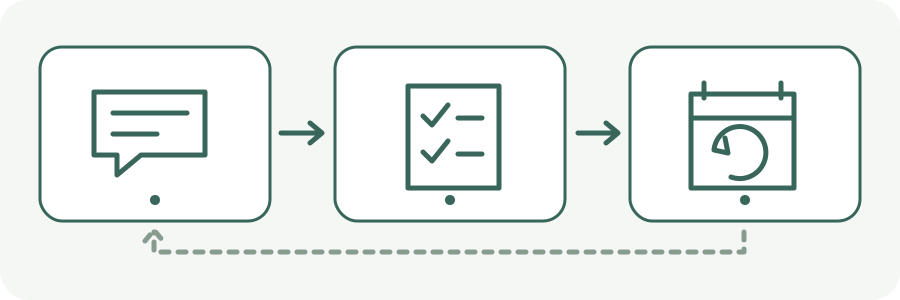
An editorial illustration of what can be discussed, not a mandatory sequence, session count or tested treatment protocol.
- Describe
A specific situation and the question you want to address.
- Discuss
An option, its constraints and what remains unconfirmed.
- Review
What happened in practice and what needs another conversation.
Give the conversation a question, not just a verdict
‘I need more willpower’ describes a judgment, but not what you want the counsellor to help with. You might instead bring ‘I don't know what to do when colleagues go out to smoke’, ‘The plan doesn't fit my evenings’, or ‘I'd like to discuss help but haven't decided to start’. These are examples of agendas, not a test of readiness or a list you must complete.
You can say which question matters most and ask what the service can cover. A behavioural conversation need not settle your whole history at once. If you do not understand a word or the purpose of a question, ask for an explanation. You are discussing your experience with a real service; this website does not provide a counselling session or take a personal history.
Describe the transition where the old routine takes over
Try distinguishing the setting, the invitation and the function of the cigarette. In an invented example, ‘I smoke during breaks’ becomes ‘When work stops, my colleagues head outside. I want company, so I follow’. That gives a counsellor more to discuss than the label ‘weakness’: companionship, a permitted smoke-free place, the reply to the invitation and what is available at that workplace.
The NCI/VA material describes counselling about triggers and changed routines. It does not establish that every urge has one learned cause. A counsellor may ask about thoughts, expectations or other difficulties; do not use this page to decide that a health concern is only a habit. Describe uncertainty too: ‘I don't know which part matters’. No smoking log or proof is required by this article; any records requested by a provider follow that provider's actual rules.
Discuss an option and what would make it usable
Continue the fictional break-time example: the suggested alternative is a smoke-free break with a colleague. It is not usable if the colleague is unavailable or that place is closed. Say that before accepting it. You could ask, ‘What could I do when neither is available?’ or ‘Can we practise a short reply without having to defend my decision?’ These are prompts for a discussion, not instructions that everyone must follow.
Before ending, put the discussion into your own words: what you agreed to consider, what still needs checking, and how a later review would happen if the service offers one. At review, explain what actually happened—an invitation came earlier, an alternative was unavailable, or you did not use it. That is different from concluding that you are hopeless or that one action caused success. The illustration shows a conversation returning to its real-world constraints, not a validated three-step treatment or a fixed session schedule.
Behavioural work can sit alongside care without becoming all of it
Counsellors' qualifications and roles differ. Some work within a clinical service whose qualified staff also assess health and medicines; a behavioural discussion itself is not equivalent to that assessment. Ask who handles a health or medication question rather than assuming every counsellor can prescribe—or that choosing counselling means excluding other care. Do not change treatment from a suggestion on this page.
In England, NHS Better Health lists local Stop Smoking Services; elsewhere confirm the available services locally. Ask for a conversation in a language you understand: WHO highlights culturally sensitive support in the person's primary language. A private paper note of the question you want to ask is enough for this article. No identity, smoking history, health information or session recording is entered or sent here.
What to keep in mind
Sources
The central claims on this page were checked against the sources below.
- World Health Organization: WHO 2024: behavioural support, trained personnel and language-sensitive delivery
Sources checked: 2026-10-08
- National Cancer Institute / U.S. Department of Veterans Affairs: Tobacco cessation counselling: routines, triggers and coping discussions
Sources checked: 2026-10-08
- NHS: England: local Stop Smoking Services
Sources checked: 2026-10-08
General information about adult behavioural counselling, not a counselling service, diagnosis, treatment selection or guarantee of a quit outcome.