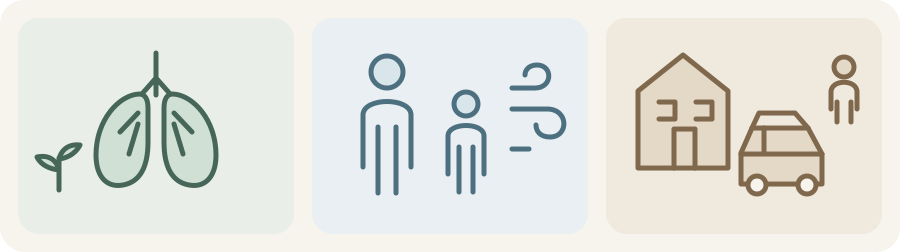
Schematic, not to scale. The panels explain context; they do not calculate dose or connect an individual child to a disease.
- Development
Organs and immune systems change with age.
- Relative exposure
Air inhaled relative to body size differs.
- Dependence
Adults shape home and travel environments.
A smaller body is not the whole explanation
Development changes how the body encounters and responds to pollutants. EPA describes different windows of sensitivity, not a rule that every substance affects every child more than every adult. For tobacco smoke, CDC identifies childhood respiratory infections, middle-ear disease, asthma attacks and slower lung growth as established concerns.
Breathing more air per kilogram is a statement about exposure relative to body size. It is not a formula for multiplying an adult risk estimate by a child’s age or weight.
The environment is chosen for them
An infant cannot choose a different home or car. Floor play and hand-to-mouth exploration also create contact with dust and surfaces. Those patterns help explain why environmental-health research considers both inhalation and deposited pollutants.
This does not make all evidence interchangeable: detecting a residue in dust demonstrates contamination, not that the residue alone caused a particular infection. The clinical evidence about secondhand smoke should not be relabelled as an exact disease-risk estimate for thirdhand residue.
What an exposure result can and cannot say
A study may measure tobacco-related material in air, contact with a surface, or a marker of exposure in the body. Another study may count illnesses. An exposure measurement and a disease outcome answer different questions.
Population evidence supports removing smoke sources. It cannot diagnose a child from a household smoking history, and an apparently well child does not demonstrate that exposure is harmless.
Source prevention is not a health certificate
CDC recommends no smoking in homes and cars, including by visitors. Smoking in another room or opening windows does not remove the problem; smoke can move between rooms and apartments. A parent’s quitting removes that parent’s continuing smoke source, but does not establish that every other source has disappeared.
The useful next question is about the setting: who can change smoking in the home, car or childcare environment? A child’s symptoms or medical concerns need qualified local care; exposure information is context for that conversation, not the diagnosis.
Sources
The central claims on this page were checked against the sources below.
- US Environmental Protection Agency: Children’s unique vulnerabilities: biology, behaviour and dependence on adults
Sources checked: 2026-10-11
- US Centers for Disease Control and Prevention: Secondhand smoke: established child health outcomes
Sources checked: 2026-10-11
- US Centers for Disease Control and Prevention: Secondhand smoke in homes and cars: source prevention and ventilation limits
Sources checked: 2026-10-11
Population-level environmental education, not an assessment of an individual child.