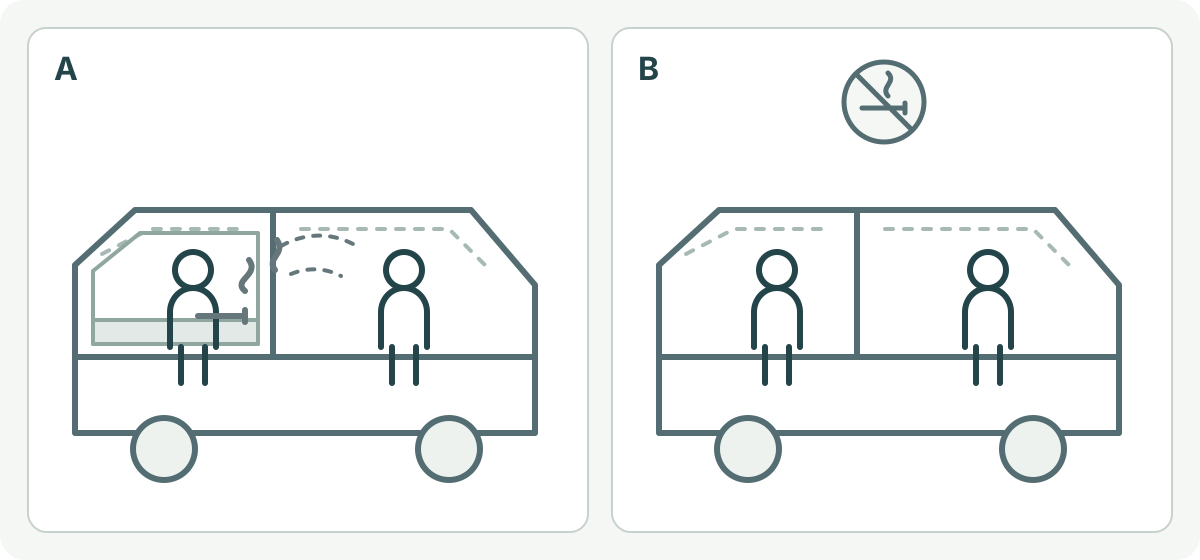
B means no smoking inside for this journey, not that every past contaminant is gone. The drawing is a comparison, not a ventilation experiment.
- A — Source remains
Opening a window does not establish that passengers avoid secondhand smoke.
- B — No smoking in the cabin
Agree before boarding. This is not a claim about old residue or all other exposure.
Agree on the source, not on how much to open a window
The CDC’s vehicle information distinguishes reduced smoke with windows or ventilation from complete elimination. It does not give a safe window combination, speed or passenger seat.
A conversation before the keys turn
Fictional editorial dialogue: Passenger: ‘Can we agree that nobody smokes in the car on this journey?’ Driver: ‘I usually open the window.’ Passenger: ‘I’m asking about not smoking inside, rather than the window. If that doesn’t work for you, I’ll arrange a different ride.’
The driver can answer yes, no or ask to change the plan. A clear answer before boarding is more useful than silently treating a half-open window as agreement. You do not need to disclose a medical history to make this request.
Different transport is an arrangement, not a punishment
Editorial example: two people are sharing a ride to an appointment. They cannot agree on the cabin rule, so one checks another ride, public transport or a changed departure time before leaving. Confirm that the alternative is actually available; do not assume every passenger has one.
If you are arranging a carpool or using a vehicle you control, tell people the cabin rule before inviting them. If you are a passenger with limited choices, ask the organiser about alternatives. This page does not determine a driver's legal obligations.
If the issue arises after departure
The driver should not operate a phone or enter notes while driving. Passengers should keep their seat belts fastened, not ask for an abrupt stop and not let an argument distract the driver. If the journey needs to change or someone needs to get out, arrange that once the car is lawfully and safely parked; this page does not tell you where to stop.
Do not make speed or window adjustment a negotiation about protecting passengers. The practical boundary is the smoking source, not an experiment during the drive.
No new smoking is not proof that old residue has gone
The EPA separately describes tobacco-smoke residue deposited on materials after smoking. An agreement not to smoke on this trip does not establish that a previously smoked-in vehicle has been fully cleaned. The residue question is separate from smoke being produced now.
What to keep in mind
Common questions
What if the cigarette is held outside the window?
That single action does not establish that passengers avoid the smoke. Do not treat the position of the cigarette as permission to replace the no-smoking cabin agreement.
Would driving faster carry it away?
Speed is not a passenger-protection setting to choose here. Do not speed up or change driving to manage smoke. Decide the cabin rule and transport arrangement before leaving.
Can I return after a set airing-out time?
This page gives no countdown for a smoke-free cabin or for removal of residue. A timer is not a replacement for stopping new smoking in the car.
Sources
The central claims on this page were checked against the sources below.
- US Centers for Disease Control and Prevention: STATE System Vehicles Fact Sheet — windows and ventilation; last reviewed 2024-09-24
Sources checked: 2026-10-01
- US Environmental Protection Agency: Secondhand smoke and electronic-cigarette aerosols — deposited tobacco-smoke residue; updated 2026-06-09
Sources checked: 2026-10-01
General environmental-health information and fictional trip examples. No personal-dose estimate, safe vehicle certification or advice to change driving behaviour.