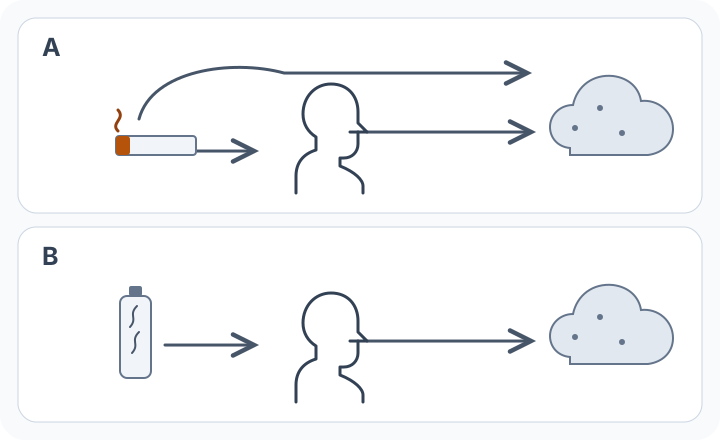
Source schematic, not an amount comparison. The cloud marks do not represent measured particle counts or a disease probability.
- A · Burning tobacco
Smoke from the product and exhaled smoke both enter surrounding air.
- B · Heated liquid
Aerosol passes through the user, then exhaled aerosol enters surrounding air.
Two ways emissions reach the room
In diagram A, both the burning end and the person's exhaled smoke contribute to surrounding air. In B, the liquid-heating device produces aerosol that the user inhales and then exhales into surrounding air. B concerns liquid-based electronic cigarettes, not heated-tobacco products.
The arrows explain a source and a route. They do not show how much a particular bystander inhales. The EPA notes that devices, liquids and their operation affect what is emitted; the small cloud symbols are illustrations, not comparable measurements.
Different chemistry, without a safety shortcut
The German BfR reports substantially lower amounts of carcinogenic and other harmful substances in electronic-cigarette emissions than in cigarette smoke under intended-use conditions, while also warning of health risks. That comparison is about emissions; it is not a measured risk reduction for every bystander in every room.
For secondhand tobacco smoke, lung cancer and cardiovascular harms are established population-level outcomes. For secondhand electronic-cigarette aerosol, the EPA identifies potentially harmful constituents and the need for more research on human-health impacts. A gap in long-term evidence does not mean harmlessness, and tobacco-smoke disease findings cannot simply be copied over unchanged.
What a room reading actually answers
Imagine a fictional report: ‘A visible cloud appeared; particle concentration rose; no chemical-specific analysis was performed.’ It tells you about appearance and a particle measurement under those conditions. It does not establish which chemicals made up the particles, their complete quantities or anyone's future disease probability.
If another report tests one named chemical, it answers an additional, narrower question. It still is not a complete mixture analysis or a long-term disease study. Start with ‘What was measured?’ rather than converting a cloud or sensor display into a personal risk score.
Separate a health question from a quitting-support question
For concerns about your own health after bystander exposure, ask a qualified local health professional. Explain which source was present and the setting without trying to calculate a dose from this diagram.
If you use the emitting product and want help stopping, ask a qualified cessation service what support it offers for that product. The EPA links quitting resources, but cessation support and indoor-air measurement are different services.
What to keep in mind
Sources
The central claims on this page were checked against the sources below.
- US Environmental Protection Agency: Secondhand Electronic-Cigarette Aerosol and Indoor Air Quality — updated 2026-04-22
Sources checked: 2026-10-02
- US Environmental Protection Agency: Secondhand Tobacco Smoke and Indoor Air Quality — updated 2026-04-22
Sources checked: 2026-10-02
- Bundesinstitut für Risikobewertung: E-Zigaretten: Alles andere als harmlos — 2025-04-08
Sources checked: 2026-10-02
General source and population-evidence education, without product rankings, switching advice, personal exposure calculations, room-safety certification or treatment decisions.