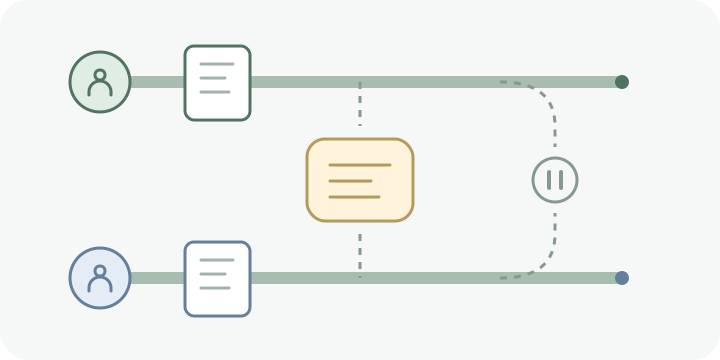
Fictional relationship diagram, not a care pathway or effect estimate. Dashed connections are voluntary.
- Your plan
Your dates, decisions and notes.
- Their plan
Their decisions remain separate.
- Shared contact
One mutually chosen activity or conversation.
- Pause
Either can stop contact without cancelling the other's plan.
Agree on what is shared—and what remains yours
Smokefree.gov encourages specific requests and inviting someone close to quit together, while warning against controlling or critical interactions. Two people can have different dates, professional support and preferences. A shared appointment to talk does not make one responsible for the other's smoking outcome.
Choose one shared activity both actually want, and keep decisions, private notes and healthcare separate. Neither person needs to supply a cigarette count, screenshot, location, password or proof. An agreement to talk is not permission to search belongings or forward messages.
A conversation you can adapt, not a contract to sign
Invented example: Alex says, ‘Would a short call on Tuesday suit you? I want company, not a check of whether I smoked.’ Sam replies, ‘Yes, but I won't always answer immediately. Shall we start by asking whether we want listening, ideas or just to chat?’ Alex: ‘Good. We can say “not today” without explaining, and we each keep our own notes.’
Sam adds, ‘If either of us changes plans, the other can keep theirs. We won't reset both people's records or turn it into a race.’ They choose a short message to cancel the call and another time to reconsider the arrangement. Tuesday is an example, not an evidence-based contact schedule. Both people's capacity matters.
Keep the reply usable when something changes
If one voluntarily says they smoked, the other can ask, ‘Would you like me to listen, do our agreed activity, or help find professional support?’ No interrogation, forced explanation or comparison of streaks. A missed reply means unavailable or unknown, not proof of smoking or lack of commitment.
Either can pause contact; a pause does not cancel the other person's plan. If the arrangement becomes humiliating, controlling or unsafe, stop the shared arrangement and seek a different safe support route. A friend is not an emergency service, clinician or person obliged to be reachable all day.
What research does—and does not—promise for a pair
A 2018 Cochrane review, searched through April 2018, tested efforts to increase partner support alongside a comparable cessation programme. It did not establish a clear abstinence advantage at six-to-nine months or twelve months and beyond; certainty was low. Most supporting partners did not smoke, and most tested programmes did not demonstrably increase received support. That does not test every two-smoker agreement or prove companionship useless.
Judge this example on consent and whether it makes contact clearer, not a health-result guarantee. Personal treatment remains an individual discussion with qualified help. NHS Better Health lists routes in England; outside England use local services and confirm access. Keep these routes available even if the shared arrangement ends.
What to keep in mind
Sources
The central claims on this page were checked against the sources below.
- US National Cancer Institute / Smokefree.gov: How relationships affect your quit journey: requests and quitting together
Sources checked: 2026-10-05
- US National Cancer Institute / Smokefree.gov: How to support your quitter: listen, avoid lectures and counting cigarettes
Sources checked: 2026-10-05
- Cochrane: Enhancing partner support (2018), search April 2018: intervention versus comparable support
Sources checked: 2026-10-05
- NHS Better Health: Ready to quit smoking — local support in England
Sources checked: 2026-10-05
Adult communication example, checked 5 October 2026. Dialogue fictional; no clinical protocol, outcome guarantee, shared private record or data submission.