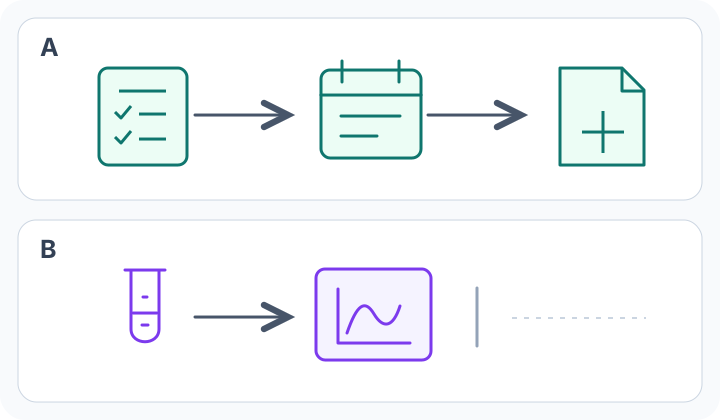
Original research-design schematic, not a pathway that makes disease inevitable. Icons and the curve are not counts, glucose values, risk estimates or a personal schedule.
- A — Start without type 2 diabetes
Record smoking categories before following new cases; specify the reference group.
- A — Follow-up and new cases
Duration and case-verification method define the incidence question.
- B — Measure a functional response
An insulin-related experiment can inform a mechanism without recording future disease occurrence.
The link is not just the sugar people eat
Insulin, produced by the pancreas, helps cells take up glucose from the blood. When cells respond less effectively, the pancreas can initially compensate by producing more insulin. If that compensation becomes insufficient, glucose regulation is disrupted. Insulin resistance describes reduced response, not the complete absence of insulin.
The smoking evidence review describes inflammation and oxidative stress linked to tobacco smoke, impaired insulin action and research on pancreatic-cell function. These provide biological explanations that complement incidence studies. A study measuring new cases does not itself identify every cellular step in each participant, and an experiment with nicotine is not a comparison of all nicotine products.
To study incidence, begin before diabetes is present
Pan and colleagues’ 2015 review included 88 prospective studies in adults without diabetes at baseline. It examined cases recorded during follow-up, with different studies using reports, records or clinical measurements. Eighty-four studies contributed evidence on active smoking. That design addresses development of diabetes, rather than simply comparing today’s glucose values.
The comparison group still matters: current versus never smoking, current versus non-current smoking and ever versus never smoking are not identical contrasts. Nor is a relative increase in a group comparison the percentage of people who will develop diabetes. The observation period and underlying rate remain part of the meaning.
Specific limitations do not erase the overall causal conclusion
Self-reported smoking, baseline-only classifications in many studies, different ways of verifying diabetes, variation between populations and residual confounding limit a pooled estimate. The review also included English-language publications only. The Surgeon General’s causal assessment synthesizes several kinds of evidence; it is not equivalent to saying that one observational estimate proves every mechanism.
Comparisons involving recent quitters need particular care. This review lacked direct comparisons of recent quitters with continuing smokers in its relevant cessation analysis. A higher value against never smokers therefore cannot establish that stopping smoking caused harm or that continuing would be safer. It supplies no personal timetable.
Keep research interpretation separate from personal care
In the diagram, A follows a disease-free starting group toward newly recorded cases; B measures a functional response in an experiment. They can inform each other, but B cannot replace A’s follow-up. An existing diagnosis and its complications are a further question, not the endpoint of this incidence comparison.
For personal glucose results or diabetes concerns, use qualified clinical services where you live. The NHS route cited here concerns GP access in England, not universal English-language care. This page does not set screening intervals, glucose thresholds, dietary plans or medication changes; smoking-support services and diabetes care also have different roles.
What to keep in mind
Sources
The central claims on this page were checked against the sources below.
- US Surgeon General / Centers for Disease Control and Prevention / NCBI Bookshelf: Other Specific Outcomes — Diabetes — The Health Consequences of Smoking—50 Years of Progress, 2014
Sources checked: 2026-10-02
- Centers for Disease Control and Prevention, United States: Diabetes and Smoking — 2024-05-15
Sources checked: 2026-10-02
- The Lancet Diabetes & Endocrinology / PubMed Central author manuscript: Relation of active, passive, and quitting smoking with incident type 2 diabetes: a systematic review and meta-analysis — Lancet Diabetes & Endocrinology 3:958–967, 2015; DOI 10.1016/S2213-8587(15)00316-2
Sources checked: 2026-10-02
- Institut für Qualität und Wirtschaftlichkeit im Gesundheitswesen, Deutschland: Diabetes Typ 2 — aktualisiert am 18.10.2023
Sources checked: 2026-10-02
- NHS, England: Register with a GP surgery — last reviewed 2025-07-28
Sources checked: 2026-10-02
General education on type 2 diabetes development and population evidence; no personal diagnosis, screening programme, glucose interpretation or diabetes treatment advice.