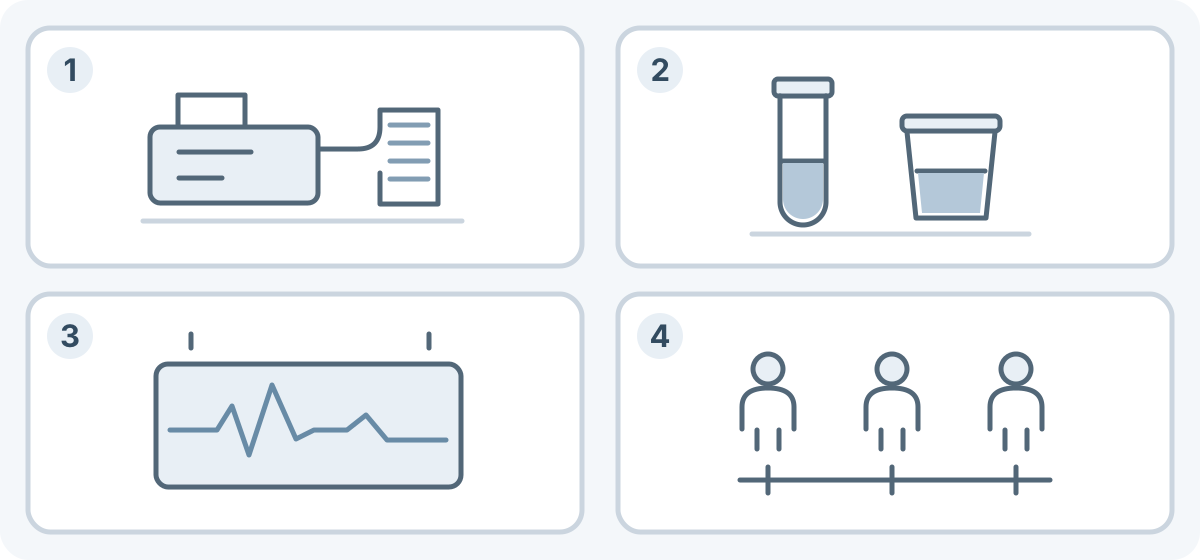
An explanatory diagram, not study data. The numbers identify panels, not levels of safety or quality.
- 1 · Emissions
What was collected from a specified product under a test protocol?
- 2 · Exposure
Which substance or metabolite was measured in people, and when?
- 3 · Bodily response
Which physiological marker changed during the observation?
- 4 · Disease outcome
Which defined health event occurred over what follow-up?
Identify the material, not just the electronic device
Heated-tobacco products heat processed tobacco leaf. Liquid e-cigarettes heat an e-liquid, which may contain nicotine. Both can have batteries and cartridges; appearance and words such as ‘smoke-free’ do not settle the category.
CDC also describes a hybrid arrangement in which aerosol from a heated liquid passes through a tobacco plug. A liquid component therefore does not automatically mean ‘no tobacco leaf’. Read the material description and how the aerosol is produced; leave the classification unresolved if that information is missing.
Ask which of four questions the result answers
An emissions test collects material produced under a specified machine protocol. An exposure study measures something in people that indicates contact with a substance, such as a metabolite. A physiological study examines a bodily response, such as a vascular or inflammation marker. A disease study follows defined health outcomes over time. The same word ‘lower’ means something different in each setting.
These are not four steps that automatically lead to a safety conclusion. A 2018 BfR study found lower amounts of selected chemicals for the tested heated system under machine conditions; it did not measure a person's future disease. A later systematic review distinguishes exposure markers from potential-harm markers and stresses that surrogate measurements alone are not definitive clinical outcomes.
Read a real evidence limit, not ‘no research exists’
The systematic review first published in April 2025 searched through December 2024. Of 40 included trials, only nine lasted longer than five days; 19 involved just one use. It found mixed short-term marker results and substantial problems with bias, study conditions and industry dominance. Those limits matter when a headline claims long-term health improvement.
This does not make every measured change imaginary. It means the measured outcome must keep its name: an exposure marker is not a cancer rate, and a short observation cannot supply decades of follow-up. This review cannot by itself rule on every later study or every product; read its search date as well as its publication date.
What the 2026 FDA authorization does—and does not—say
The April 17, 2026 renewal followed scientific review and applies to the specified products and exposure-modification wording. FDA found those claims supported and the products expected to benefit population health as a whole. It also explicitly prohibits claims that mislead consumers into thinking the products are endorsed, FDA-approved or deemed safe.
Keep the U.S. jurisdiction and complete-switching condition attached to that decision. An exposure claim for a specified system cannot be transferred to another device, dual use or bystanders. ‘Authorized for this claim’ is different from ‘approved to help me quit’ and from a personal disease-risk reduction.
Work through one invented headline
Fictional headline: ‘Product X produces less substance Q, so your heart-disease risk falls by the same proportion.’ Suppose the accompanying report describes a machine test against one cigarette, with no human follow-up. The useful reading is: ‘Less Q was collected under this protocol.’ The claim about a person's heart disease has not been measured in this example.
Now change the report: suppose Q is measured in urine after a complete switch. That would answer an exposure question in the people and period studied, not the same question as the machine test—and still not a disease rate. Ask for the actual result, comparison group and follow-up rather than filling the missing outcome with a reassuring percentage.
For a personal decision, ask a different question
Instead of ‘Which device gets the best health grade?’, bring the exact product information to a qualified professional and ask about stopping tobacco use and available support. A public comparison cannot select a product, interpret a test or decide a treatment for you.
In England, the NHS service finder locates stop-smoking support by town, city or postcode. Check arrangements directly with the service; the finder does not certify a device or guarantee an appointment. Outside England, use the official route where you live.
What to keep in mind
Common questions
Does less smell or less visible aerosol tell me the risk?
No. A sensory impression is not a complete chemical measurement or a disease study. Use the actual product and evidence, not appearance, as the basis for reading the claim.
Does uncertainty mean heated tobacco and cigarettes are identical?
No. Their measured emissions can differ. The point is to describe the supported difference precisely, not turn uncertainty into either ‘identical’ or ‘safe’.
Can I use a biomarker result as my own health score?
Not from this page. The substance, sampling window, product use and purpose of the test matter. Interpretation of an individual result belongs with the professional responsible for it.
Sources
The central claims on this page were checked against the sources below.
- US Centers for Disease Control and Prevention: Heated Tobacco Products — materials, hybrid designs and limits (2024-05-15)
Sources checked: 2026-10-01
- US Food and Drug Administration: FDA renewal of exposure-modification authorization for five specified heated-tobacco products (2026-04-17)
Sources checked: 2026-10-01
- Braznell et al. / Tobacco Control; PMC full text: Impact of heated tobacco products on biomarkers of potential harm and adverse events: a systematic review and meta-analysis — first published 2025-04-29; search to 2024-12
Sources checked: 2026-10-01
- Bundesinstitut für Risikobewertung: Wie gefährlich sind Tabakerhitzer? — specific machine study (2018-05-18)
Sources checked: 2026-10-01
- NHS: Find stop smoking support services — England
Sources checked: 2026-10-01
General product and research education, not a health-product ranking, individual risk estimate, test interpretation or cessation prescription. It does not recommend heated tobacco or promise a health or quitting outcome.