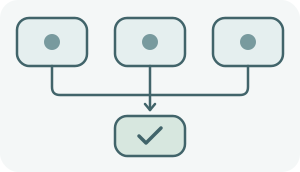
Concept diagram of the endpoint in Lee et al. (2021), not a recovery pathway. Meeting any component qualifies; participants do not have to experience all three.
- eGFR falls by at least half
A reduction of at least 50% from the study baseline, not an improvement.
- Dialysis starts
A clinical event, not a prediction made from quit days.
- Kidney transplantation
Another qualifying event, not a required next stage.
A composite endpoint is not a kidney-function score
The published KNOW-CKD abstract describes 1,951 patients in a Korean cohort, followed for a mean of three years. The primary outcome combined a reduction in estimated glomerular filtration rate (eGFR) of at least 50%, starting dialysis, or kidney transplantation. A participant could meet the endpoint through any of these components. A result for the combined outcome does not establish the same effect separately for all three.
eGFR is an estimate of filtration, not a percentage of healthy kidney tissue. Here, ‘50% reduction’ describes change from the research baseline. It is not a rule for diagnosing yourself, deciding when dialysis is needed, or measuring how much damage quitting has repaired.
Why a study called a trial still needs a smoking caveat
SHARP was a randomized drug trial, but its smoking analysis was observational: participants were not assigned to smoke or quit. Among the 6,245 participants not receiving dialysis at baseline, the analysis found no significant association between current versus never smoking and progression to kidney failure requiring dialysis or transplantation. It nevertheless found higher vascular-event and mortality risks among current smokers. An inconclusive renal result is not evidence that smoking is safe.
Smoking status was recorded at baseline, not reassessed during follow-up. The researchers could not directly evaluate quitting during the study. The renal comparison therefore cannot be relabelled a randomized test of cessation.
A quit anniversary cannot turn this into a forecast
The KNOW-CKD publication reported lower adverse-kidney-outcome risk with longer smoke-free periods among former smokers. The 2025 review also describes analyses of coronary calcification and cardiovascular events from the same cohort, with different participants and endpoints. Those are not additional kidney-recovery studies. The review notes baseline-only smoking information; neither a duration category nor a nonsignificant difference establishes equivalence with never smokers or a personal recovery year.
Keep cessation support and renal follow-up working together
For a clinical report, ask your kidney team: ‘Is this a trend in filtration, a risk estimate, or a combined study outcome?’ Continue agreed monitoring; don't change medicines, fluid intake or diet on the basis of a smoking article. In England, NHS local stop-smoking services provide a route to separate cessation support. This page needs no laboratory results or medical history from you.
What to keep in mind
Sources
The central claims on this page were checked against the sources below.
- Nicotine & Tobacco Research / Oxford University Press: Lee et al. (2021; online 2020): Smoking, Smoking Cessation, and Progression of Chronic Kidney Disease; published abstract, endpoint and follow-up
Sources checked: 2026-10-08
- American Journal of Kidney Diseases: Staplin et al. (2016): Smoking and Adverse Outcomes in Patients With CKD (SHARP); Methods, renal results and limitations
Sources checked: 2026-10-08
- Korea Disease Control and Prevention Agency / Public Health Weekly Report: Joo et al. (2025): Review of evidence from KNOW-CKD; Table 1 and baseline-only smoking information
Sources checked: 2026-10-08
- NHS: Chronic kidney disease: treatment depends on clinical stage; smoking cessation as part of care
Sources checked: 2026-10-08
- NHS: England: local stop-smoking support
Sources checked: 2026-10-08
General research education, not eGFR interpretation, a dialysis decision, treatment advice or a prediction of your kidney disease course.